 Barber Blogs
Rock On
Rock On
Summer to Fall 2026, Written in Various Locales. Photo Credits: Tim LaBarge
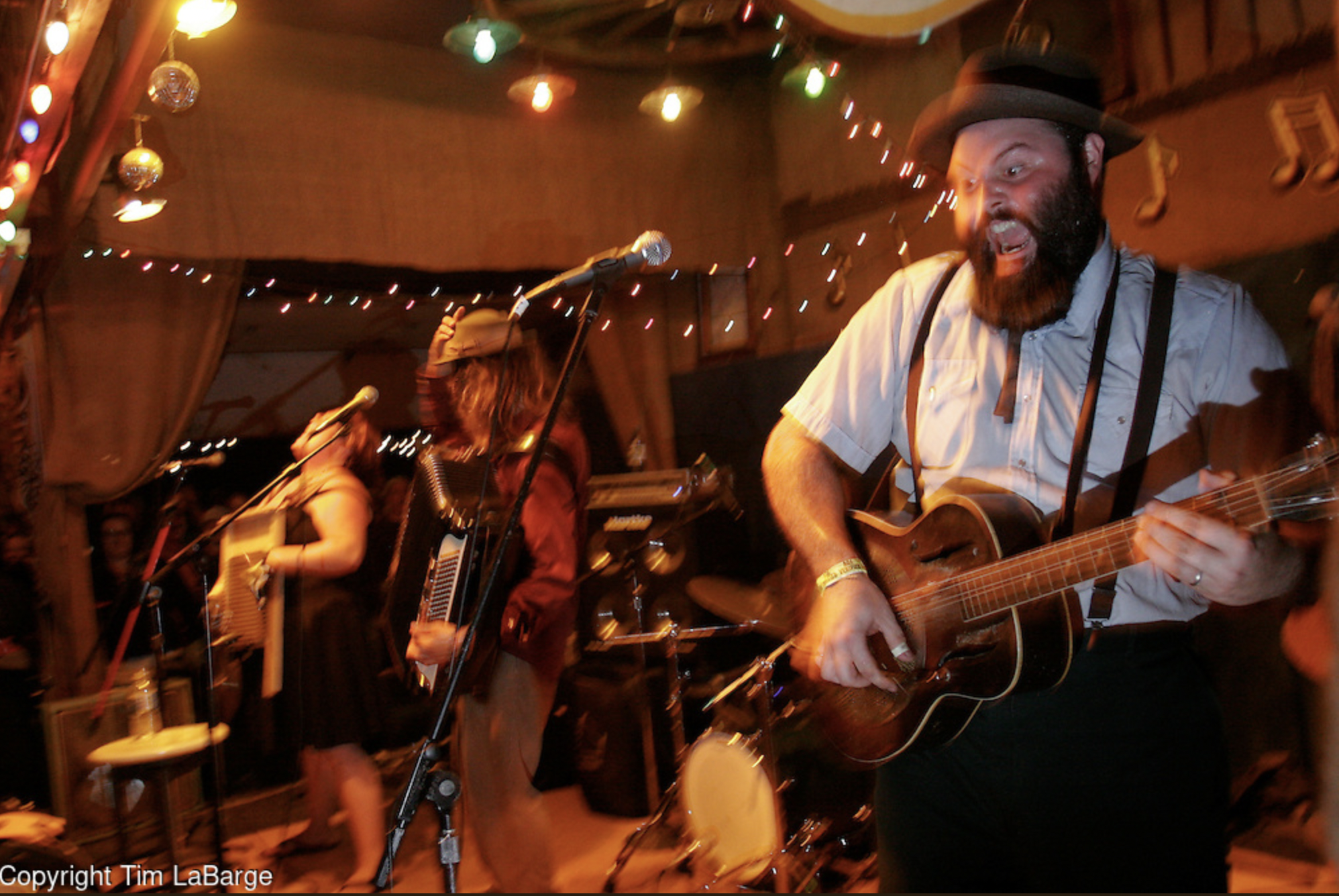
If the word means nothing to you, you’re probably doing things right. Etched into 80 acres of Pendarvis Farms in Happy Valley, OR, Pickathon is a four-day music festival cloaked in secrecy and leafy groves, fueled by word of mouth. Billed as “A musical ride through nature” and “a summer camp for the soul” (pickathon.com), Pickathon is packed with fixtures: wooded inlets of tents and community spaces, nine different stages of varying size, backdrop, and clientele, food trucks and water spigots, alleyways of porta-potties, playgrounds, bars, and a single multicolored glass structure for children, whose intended purpose I never found out. The weekend jamboree has given formation to bands such as Geese and Billy Strings, a sort of sylvan launching pad to alternative stardom. I’ve known about it for quite a long time via our family friends, the LaBarges, who have been dedicated Pickathoners since 2006. Tim LaBarge, the chief photographer of Pickathon for over 20 years and author of Pickathonography, articulates its magic as thus: “There’s a deep love and respect for this festival that goes beyond just an interest in music. It’s about people.”
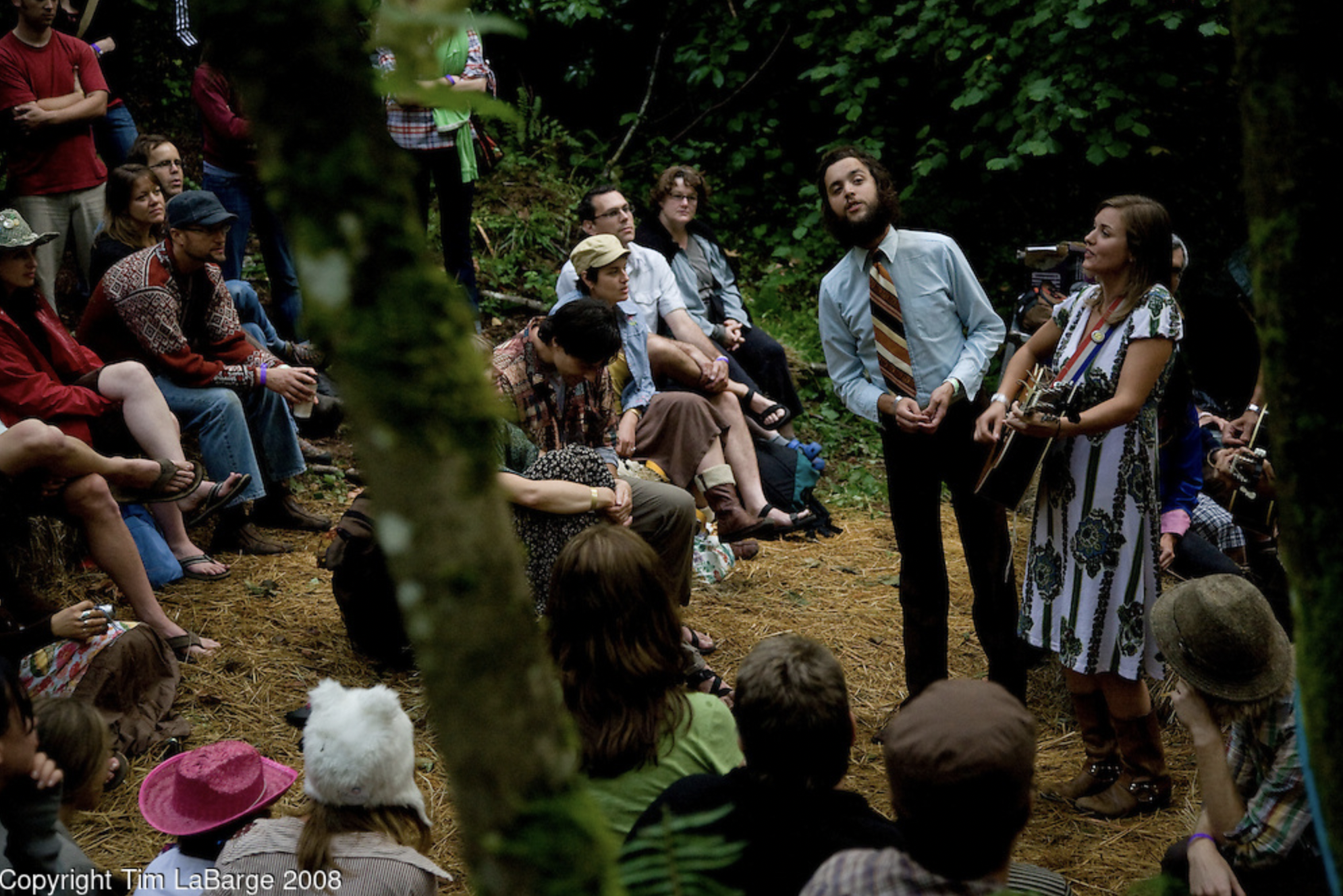
The day’s heat cooked the air under a high flame. Most of the concertgoers in the line were scantily clad, protected under foliages of artsy hats and bandanas, with jangling mountaineering backpacks. The way to do Pickathon, the LaBarges advised, is to bring a book, plenty of water, be prepared to take multiple siestas, and avoid expelling all of your energy. The counsel felt strange within the context of a music festival, as I was eager to experience every single show I could, hydration or rest be damned. Seymour, my younger brother, appeared to have taken the advice in his own fashion; aside from his phone, all he carried was a single couch pillow. We boarded the yellow school bus, acting as the official shuttle to the entrance, and were thrown around by the grassy knolls underneath. The last time I rode such a bus was en route to high school cross country dual meets, where I felt the same nervous anticipation from the expectation of severe physical exhaustion at the evening’s close. The ride was mercifully short, and after an inspiringly lax backpack check, we were in.
Save for the Mexican Institute of Sound, the festival’s lineup was unknown to me, but stunned in their musical diversity. Constellated across 12 hours, the program comprised everything from Nashvillian bluegrass to politico-feminist punk outfits; Argentine multi-instrumental soundscapes to Taylor Kingman and the Electric Skeleton. Even just walking through the festival’s acreage without pausing at any stages forces you onto a musical odyssey, like a Spotify playlist gone horribly right. Upon our noon arrival, we had already missed the spiritual Cosmic Tones Research Trio (jazz), as outlined in my Dad’s tentative schedule for the day. His was a detailed, anal itinerary, whereas my tentative one went as follows:
∙ 11am: 50mg of Molly stirred in a Vodka Redbull
∙ 11:10am: Meet Amethyst in the woods to smoke crystallized toad venom
∙ 11:10am-11:59pm: Survive.
∙ 12am: Family Company (the band)
My actual circuit of choice, inscribed on a folded sheet of notebook paper complete with map and bar locations, included Automatic, an all female trio of synth pop; Forty Feet Tall, a noisy punk ensemble that seemed fertile for moshing; and Rumbo Tumba, an Argentine multi-instrumentalist that from a brief online search seemed to give anyone from NPR and Pitchfork a half chub.
I took my spectatorial talents to the Windmill stage, first passing a shirtless beer-bellied bald man roaring drunken epithets, where the Hogslop String Band was in full sonic swing. Seymour and I took our seats on a log bench, listening to the frenetic banjo and percussive double bass lilt over fiddler/singer Kevin Martin’s growled lyrics. Interspersed between tracks were many a crowd address, such as “Our new record is out, mail it to someone you hate… it’s a win win for all of us” (laughter). It was then that I began to feel the first pricklings of the Pickathon Dilemma, FOMO in organic form: what if I’m missing an even better performance at another stage? The tugging and pulling of Pickathon lust represents a deep problem, as it feels antithetical to the festival’s ethos. The environment and schedule are architectured to be a fully present, enlivened experience, free from perils such as fragmented attention or solitude. Yet it also, in its abundance and sheer fun, provides a garden of earthly delights, a gnawing hunger to not miss a single performance, leaving no hidden cranny of experience or soil unturned. I succumbed in this first hour, leaving the Windmill to head towards Clinton Fearon at the Woods stage. As I exited, Martin launched into his next song with the prelude “We’re the HogmotherfuckingStringBand!” –which launched the dilemma into top gear, making me white-knuckle away through swelled crowds.
It wasn’t always like this, in terms of sheer numbers and infrastructure. Pickathon’s first year was held at Horning’s Hideout, a park in North Plains, intended as a fundraiser for the local radio station KBOO. Zale Schoenborn, the festival’s founder, noted that the first Pickathon’s attendance tallied around 90, with performers and dogs almost outnumbering attendants. But the shoestring festival miraculously held on in those early years, and in 2006, relocated to Pendarvis Farm, with turnout and venues increasing in number. The scuttlebutt that I picked up from festival veterans is that Pickathon, though now comparatively massive to its humble beginnings, still loses money almost every year. That doesn’t seem to repel local nonprofits and architectural firms becoming enjoined with the event’s assembly, alongside Oregonian artisans sprinkling their timbered visions across the festival’s agriculture. Each stage and land plot seems to by now have its own biography. The Windmill’s ligneous “kit of parts”, after being musically used, is handed off to Portland nonprofit Sabin CDC, the sound-soaked lumber reused in various housing projects across the city. The Woods Stage is reinvented septennially, and 2026 marked the end of its most recent arc, "its fullest flower, before the next rebirth begins.” The Porta Potties seem to be just Porta Potties, but hopefully they enjoy a cycle of rebirth more frequently than every seven years.
Although Pickathon has checkpoints and bag checks throughout, the stations felt more for legal compliance than anything security related. Most of the volunteers were young adults, and in exchange for searching backpacks with the briefest glance and giving ill-informed map directions, they got to experience the festival in their off hours for free. The profiteering was mutual, too; a college-aged volunteer gave me a free margarita because she liked my earrings. It pays to be cute as a button.
To get to the Woods, you must pass through the woods. On the edges of timber chipped paths, towering Douglas Firs shade rows of children offering $1 face painting and Pokemon cards. To the right lies The Refuge, offering addiction support, Qi Cong, and yoga classes. It was one of many examples of Pickathon’s refuges-within-refuges, its Russian nesting doll of green spaces and programmed events. Musical acts didn’t all seem to require capitalized stage names, as guitars, flutes and tambourines jostled wildly in spontaneous jam sessions. Just before Fearon, a miniature platform had been erected for busking, where a 10-year old brotherly duo fiddled a screechy rendition of Beethoven’s Moonlight Sonata, which was almost listenable.
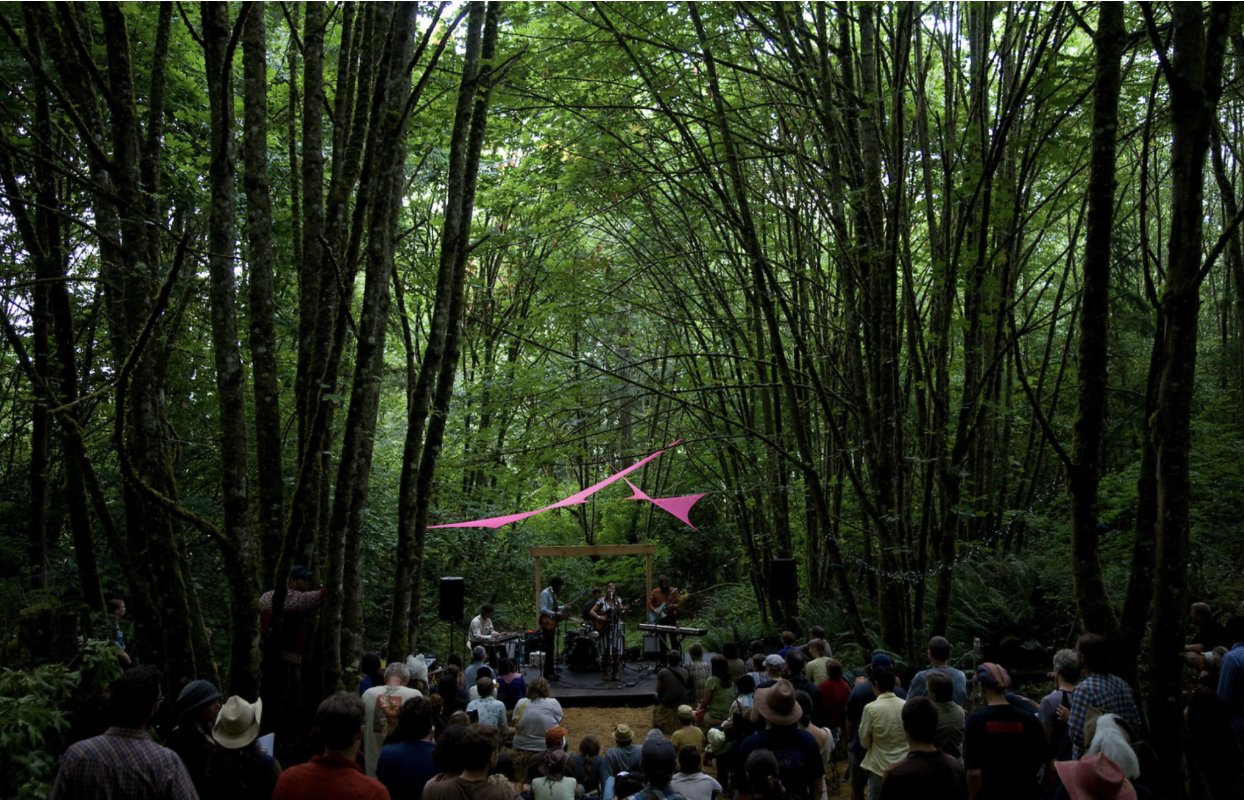
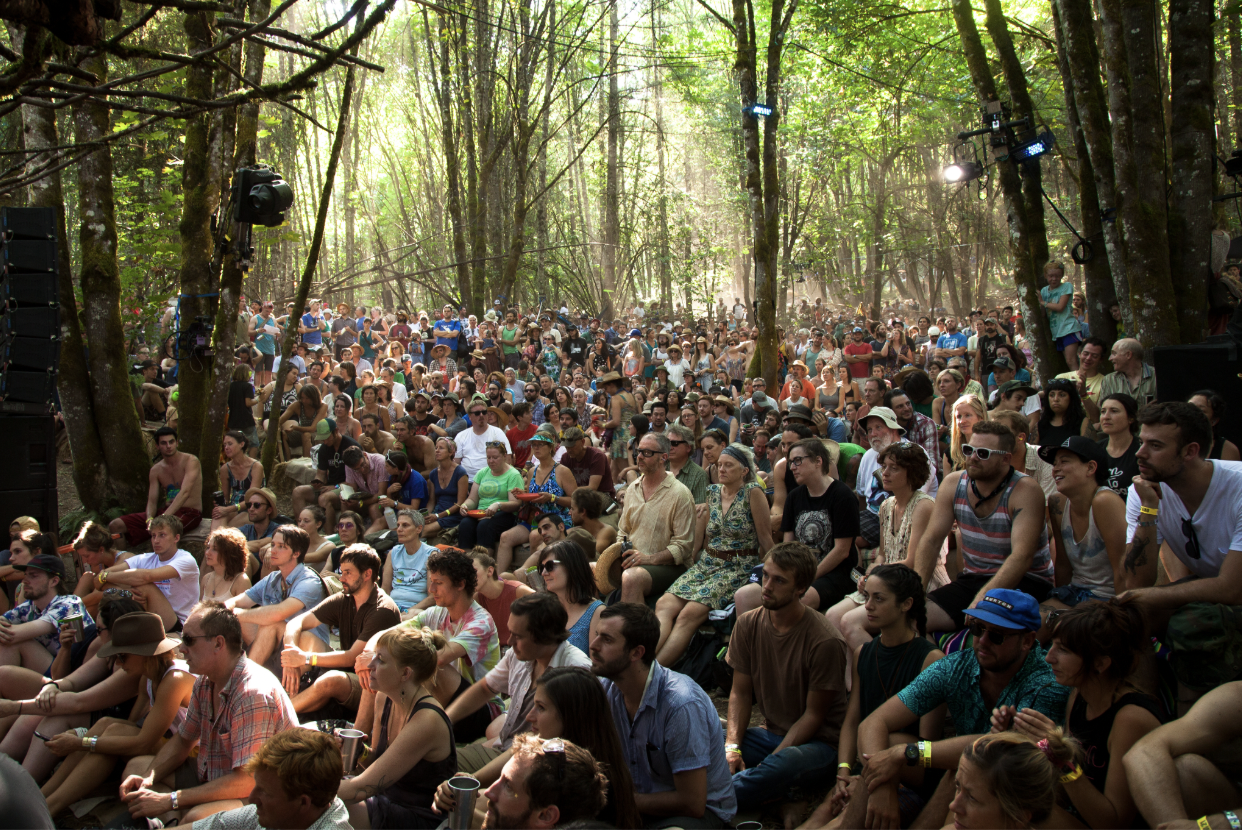
Clinton Fearon was wrapping up his set by the time my hike was over, but any disappointment was quickly softened by the scenery. The Woods stage seemed the grandest of all, set within a gentle dell, with pulsating red and blue stage lights ricocheting arboreally. The crowd didn’t seem to be in any rush to exit the pit as Fearon’s reggae faded. Folks rested languorously on the dark soil, nodding off against trees, continuing or initiating conversation. According to my crumpled paper, the next couple hours were a relaxing furrow before a formidable evening crest. The day’s heat blistered in open pockets of sun, sending most under shaded thickets of tentware. Seymour and I found a curved platform by the Paddock and took a nap, letting chatter trickle through our ears. After our siesta, a nadir of sorts filled the next three hours. PISS offered a buffer against the afternoon’s haze, and their name felt analogous to their sound, if one had to micturate with two kidney stones after a Bloody Mary. I tried to enter the Lucky Barn to see Ken Pomeroy, the former a rustic structure bedecked in Western iconography, the latter a 23 year old Cherokee folk singer with deft guitar chops. No dice. The barn was filled to the brim, no doubt in part to the venue’s air conditioning, which sent sporadic wafts of cold air to the mendicants on the outside. The heat began to sap what was left of me, and I swayed throughout the festival, resting in sought-after pockets of shade. After an attempt to enjoy Briscoe at Cherry Hill, which was thwarted by the sun’s blaze, I made a forced retreat to a shaded section with Seymour and Dad in tow. Seymour, still clutching the couch pillow and with a gaunt look in his eyes, summed up what we all felt at some level: “This festival blows.”
The flowing vats of alcohol stationed around the festival helped immensely, too. Here are my in situ notes from the hours of 5-6pm:
unremembered, alcojol is. Wonderful beverage that is nkt addictobe or hamful
– not that substances are required to participate in, or even enjoy Pickathon. Nevertheless, I felt that some amount of substance ingestion would help me integrate into its Woodstockian nature. I stumbled back into the Lucky Barn, having secured a sought-after position at the back to see Rumbo Tumba. From the name, I expected an uproarious cavalry of band members and instruments, but it was just Facundo Salgado up there, surrounded by drums, pianos, mics, and a mandolin, stitched together by cords of looping equipment. As with all recursive compositions, Salgado’s performance was actively chiseled and shaped before the audience. He began with a mandolin riff, grabbed the bass to lay down some extra padding, and scrambled around his various devices until his voice was fully supported by his instrumented choir. After two sprawling songs, however, the concert turned into an uninspired Q & A by a journalist from a local magazine, which was my Automatic cue to leave.
Automatic, a female trio from California in the specialized field of “deviant pop music that cuts though the brain rot”, was an act I was furiously excited for. I discovered them on the way to the festival, playing their track “Black Box” on the car speaker. The word in the Woods was that their act the night before had many technical difficulties (understandable when placing electronic equipment amongst pine trees). This was par for the course, though, as Thursday (the festival’s kickoff) seemed to be the testing ground for artists at Pickathon, a chance to tinker and fine tune in the boscages before the weekend chaos. I joined up with Jack and Leo LaBarge, who have been attending the festival since before they were potty trained. Pickathoning, like most everything, is practiced better in groups, especially since any social judgement about brief sojourns for beer, new acquaintances, or bodily needs is absent.
Automatic loaded their clip at 7pm sharp (start and stop times are anally adhered to), put the safety off, and fired off synths into the canopies. However, their sound quickly jammed when the drummer’s metronome lost connection, causing extended halts to the action. But they rallied; the red lighting and a 9-year old who decided to crowd surf brought the energy back as they launched into “Black Box”, a rendition indistinguishable from their studio recording. Pickathon’s crowds were the most forgiving of any audience I’ve come across. Anger and impatience are perhaps natural at crowded warehouses or massive stages, but not so within arboretums and cowbarns. Janky instrumentals and improvisation are not only accepted, but encouraged, as if included in the festival tickets themselves.
Every year seems to be Pickathon’s last. The history, from what I gathered, is that two brothers inherited the Pendarvis Farm, one of whom reveled in the festival being hosted there. However, development inevitably inched in. Even within the last few years, much farmscape has been replaced by cookie cutter suburban developments, boosting property values at the expense of bucolic charm. The other brother is angling towards selling, so each time the farm wrangles together the festival out of volunteer work and an astonishing amount of lumber, it feels like the last hurrah, a funeral pyre made of plywood and sound smoke, going out in a blaze of glory before real estate devours it whole. A sense of urgency is present, a desire to gorge on the festival for all that it’s worth. I came to 2026 Pickathon carrying some antipathy towards concerts, and populous events in general. Most of this past year’s shows that I went to were in New York, a site not exactly known for want of performers, or fans. Such wealth of choice has hidden fees, though. The venues, along with the commutes and general tones, felt enclosed, high octane and ephemeral, much like the city itself. Something about Pickathon’s format felt more gentle and durable, an occasion where rest spots aren’t cast in concrete and start times respected. It hasn’t quite escaped the music industry’s apparatus; even with capped ticket sales and a break-even model, the cost of attendance is still on the rise, but it feels less like a compromise and more like a last stand.
Right on schedule, we hiked towards the Paddock, the “Grand Energy Under the Stars”, a massive stage with Mount Hood and a full copper moon maintaining the background. Mexican Institute of Sound were in full trumpet blare, and aside from the band and crowd’s numbers, there was nothing institutional about it. The mobs gyrated in all directions, and Camilo Lara, the producer and “cultural agitator” behind the band’s hip-hop infused cumbia, paraded with lengthy tangents about drinking and meeting potential lovers at past Pickathons. The crowd leapt in unison to Escribeme Pronto, a track of evidently mass appeal, until the trumpets faded, and it was time to get Forty Feet Tall(er). This is where knowing Pickathon vets comes in handy. I followed Jack and Leo to the Galaxy Barn, getting tangled amongst M.I.S devotees. As we passed a group, one Pickathoner exclaimed “That’s Leo LaBarge of GotFart?!”, referencing his past business venture of T-shirts and stickers with the slogan “Got Fart?” I was amongst royalty. We peeked into the Galaxy Barn, which was swarmed. But Leo, Jack and crew skirted to the back, past a flimsy orange safety fence, and suddenly we were right backstage, in those coveted areas where the only way into the crowd was past the band themselves. The group was wary of entering, perhaps thinking of their ribcages and remaining cartilage with two days of Pickathoning still to come. But I remained, with clothes now free of the day’s sweat and in need of a good soaking. While the band warmed up I struck up conversation with a festival organizer named Jora, who was freehanded with both American Spirits and insider knowledge. He claimed Pickathon, out of all of the nation’s festivals, remained true to its core and unique amongst the many. I felt tempted to press him for more tidbits, wanting to have what was so special about Pickathon spelled out for me through cigarette smoke, but I was pulled indoors by Forty Feet Tall’s amplifiers, which began to quiver the night’s air.
Is there a proper, codified way to start a crowd surf? I was asked by two Forty Feet Tallergoers for assistance in launching one of them up into the air to ride the throbbing orchestra of hands outstretched towards the Galaxy Barn ceiling. I went for a sort of knee boost position, but there came a perilous moment where the stage diver nearly pancaked me and several others after flailing unbalanced in the air, so we improvised a hasty launch; luckily, the crowd welcomed his botched entrance with open arms. I was swarmed, elbowed, shoved, Krav Maga’d, fist bumped, hugged, and then shoved. It felt as if Pickathon’s collective energy, once dispersed evenly, had concentrated violently within the small confines of the purplish byre. Forty Feet Tall plowed into one thrash punk song after another, impressively not needing many breaks. An incendiary PNW punk quartet, Forty Feet Tall has deep roots in Pickathon, which they attended themselves as children, and legend has it that their breakout act was at Pickathon itself, covering for a band that cancelled last minute. Drenched, heart leaping out of sternum, I took a break on the fringes of the rabid circle as inflatable pool toys arced violently over the mosh. Breath caught, I reentered for the last song, receiving a wicked forearm to the jaw. As the set ended, we staggered out of the barn like soldiers exiting a war zone and drank greedily from the water trough, the porcine connotations not being lost on anyone.
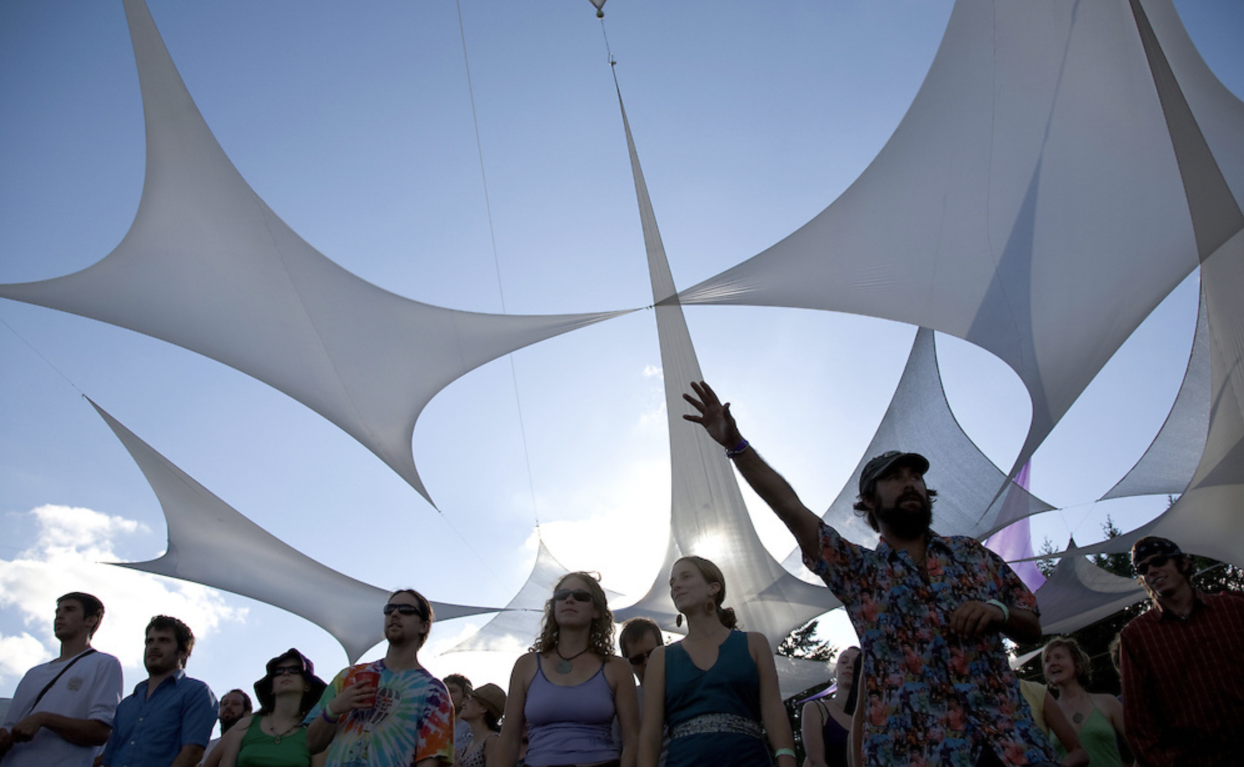
It’s difficult to make spiritual and metaphorical use out of a music festival without veering into the overly mystical. I won’t pretend in the summer days comprising Pickathon’s wake that I was irrevocably shaken into a new subjective reality. What did shake, though, was the rust off of the modern American event, a phenomenon now bemoaned for its online ticket platforms and K-shaped clientele. You can’t escape it entirely, but at Pickathon you get damn near close.
By this point in the deep night, the crowd, once slightly segregated by age group and musical tastes, globbed completely. The buttery moon hung bulbously, interrupted at various intervals by coniferous branches. Acid King, old timers of a dirgeful proto-metal sound, sludged through distorted tracks that lent a more wizened and seasoned aspect to the thick stew of mosh. I reunited with Seymour and the crew before launching into the pit, getting nearly clotheslined into the earth. Seymour disappeared into the city of tents with a female peer, finally making good use of his upholstery. Did everyone in this crowd see what I saw today? Dozens of genres in one day’s window. Characters, in varying aspects and maturity, lending items and dealing advice. IPA bars sitting right next to alleyways of vendor stalls run by middle schoolers. Hundreds like you ready to roll, musical acts creating a cross-acred mycelial symphony, varying corners of debauchery and rest, a couch pillow that has seen more than you and I could ever imagine.
✦ Comment Section ✦
★ RECENT VISITORS ★
Loading guestbook...